SEO for Government Contractors: The 2026 Dominance Guide

SEO for government contractors is the highly strategic process of fully optimizing your digital corporate footprint so that federal contracting officers, massive prime contractors, and potential teaming partners find your firm organically on Google—long before they ever log into SAM.gov. It is undeniably the single most underutilized, highly lucrative growth lever in the GovCon sector today.
The reality of modern government procurement is incredibly simple: federal contracting officers are people, and people use Google to rapidly solve complex problems. While mandated databases like the SBA's Dynamic Small Business Search (DSBS) and SAM.gov are strictly required for formal FAR-compliant market research, the crucial preliminary vetting of a contractor's capabilities almost always happens on a standard commercial search engine.
If your firm provides highly technical cybersecurity services in San Antonio, and you don't instantly appear when a federal buyer desperately searches for "8(a) certified cybersecurity contractor San Antonio," you are actively hemorrhaging revenue pipeline. In this comprehensive, data-driven 2026 dominance guide, we break down exactly how government contractors can aggressively leverage Search Engine Optimization (SEO) to build a permanent, highly compounding inbound federal sales pipeline.
Table of Contents
Why 93% of GovCon Firms Are Invisible Online
According to official federal procurement data, there are well over 400,000 registered entities actively attempting to do business with the federal government. Yet, our deep internal data analysis reveals a shocking statistic: fewer than 7% of these firms possess a website that successfully ranks on the first page of Google for any meaningful commercial or government-related search term.
The reasons for this massive digital invisibility are entirely predictable and deeply systemic across the industry:
- The Legacy Mindset: "We win massive contracts through deep relationships and crowded industry days, not websites." While relationships are unquestionably crucial, they fundamentally do not scale. SEO allows you to instantly build authoritative relationships with federal buyers you haven't even met yet, in states you have never visited.
- The "Brochure" Website: The vast majority of GovCon websites are highly static, 3-page template sites built half a decade ago. They act strictly as a passive digital business card rather than an active, aggressive business development engine.
- Zero Content Strategy: Firms rely entirely on their 2-page capability statement (often buried in an un-indexable PDF) and publish absolutely zero thought leadership, technical case studies, or critical compliance guides.
- Technical Neglect: Government evaluators instantly notice painfully slow load times, broken mobile layouts, and terrifying missing SSL certificates. More importantly, Google's core algorithm actively penalizes and buries these broken sites.

The massive silver lining? Because the vast majority of government contractors are entirely neglecting SEO, the digital space is dramatically less competitive than standard B2B consumer markets. While a B2B SaaS company might bleed $50,000 a month fighting for Page 1, a highly specialized defense contractor can completely dominate their technical niche with a mere fraction of that investment.
How Contracting Officers Conduct Market Research
To fundamentally understand why SEO is critical to your pipeline, you must deeply understand exactly how market research is formally conducted under the rigid rules of the Federal Acquisition Regulation (FAR) Part 10. The FAR strictly requires contracting officers (COs) to conduct exhaustive market research before issuing formal solicitations to determine if commercial items are available and if small business set-asides are viable.
The modern CO research stack is highly multi-channel:
- SAM.gov & DSBS: The official, mandatory databases for filtering by NAICS codes, set-aside status, and physical location.
- Google Search: Relied upon heavily to validate technical capabilities, review a firm's digital presence, and find highly specific technical solutions that SAM.gov's notoriously clunky search engine fundamentally cannot easily parse.
- GovWin / Bloomberg Government: Highly expensive premium intelligence platforms used to harvest historical teaming data and expiring contracts.
- GSA Advantage / eBuy: Used specifically for rapidly reviewing pricing ceilings and schedule availability.
- LinkedIn: Crucial for vetting the executive leadership team and verifying past performance claims against reality.
Google Search is where the battle is truly won or lost. When a contracting officer searches for "CMMC Level 2 compliant IT modernization small business," they are actively, desperately looking for a trusted solution. If your competitor's highly polished, content-rich, perfectly SEO-optimized site appears first, they immediately capture that buyer's attention and budget. If your site is buried in the graveyard of Page 4, you simply do not exist.
The 5-Pillar GovCon SEO Strategy

Highly effective SEO for government contractors isn't about cheaply gaming the algorithm with spam tactics. It is about meticulously building a digital presence so incredibly authoritative and useful that search engines literally have no choice but to recommend you. We utilize a highly proven 5-pillar strategy tailored specifically for the Defense Industrial Base (DIB) and massive civilian agencies.
Pillar 1: NAICS-Optimized Service Pages Most contractors hide their massive capabilities in a tiny bulleted list on a single "Services" page. This is a catastrophic SEO failure. Every single primary NAICS code your firm operates under must have a massive, dedicated, keyword-rich service page. If your primary code is 541512 (Computer Systems Design Services), you need a highly dedicated URL that acts as a landing page for that specific capability.
Pillar 2: Authority Content and the E-E-A-T Framework Google's algorithm heavily favors websites that demonstrably prove E-E-A-T: Experience, Expertise, Authoritativeness, and Trust. For GovCon firms, publishing weekly, highly technical content is the absolute fastest way to build E-E-A-T. Instead of writing a generic blog post, write deeply technical, actionable guides like "Navigating NIST SP 800-171 Compliance for DoD Subcontractors." Every highly technical article is a new digital fishing hook, capturing extremely lucrative long-tail search traffic from procurement officials.
Pillar 3: Technical Foundation and Core Web Vitals Your website's technical health is the unshakeable foundation of your SEO. If your site is slow or broken, Google will never rank your content. Key technical requirements include absolute mobile responsiveness, blistering site speed (loading in under 2.5 seconds), unbreakable SSL security, and complex Structured Data (Schema) to help Google parse your CAGE code.
Pillar 4: Local SEO & Google Business Profile If your firm serves a highly specific geographic region (e.g., a physical construction firm operating exclusively near Fort Cavazos), Local SEO is your most devastatingly powerful tool. Claim and meticulously optimize your Google Business Profile (GBP). Ranking in the highly coveted top 3 of the Google Map Pack drives immediate, exceptionally high-intent federal traffic to your site.
Pillar 5: Backlink Authority Building In Google's algorithm, a backlink (another authoritative website linking to yours) is a massive vote of confidence. In the GovCon space, quality dramatically outweighs quantity. You must aggressively earn links from high-authority sources, such as your local APEX Accelerator, massive industry publications like Washington Technology, and official .gov domains like the SBA's directories.
Keyword Strategy: NAICS Codes Are Your Secret Weapon
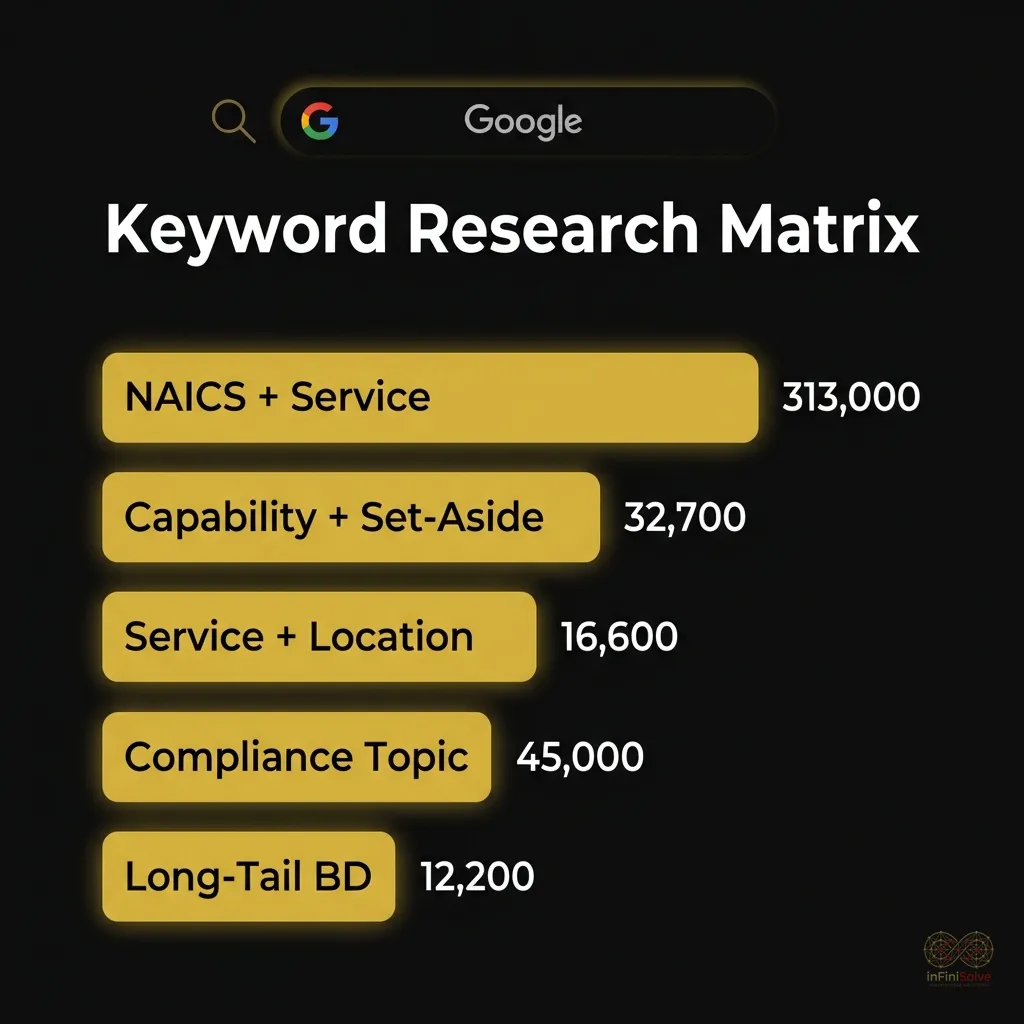
Most GovCon business developers fundamentally don't realize that standard NAICS codes and dense federal acronyms are highly lucrative, high-converting search terms. Procurement professionals and massive prime contractors search for these specific alphanumeric strings daily.
Your keyword matrix should aggressively target specific combinations, such as "541512 computer systems design services" or "cybersecurity contractor 8(a) certified San Antonio". By completely ignoring massive generic terms and laser-targeting long-tail federal keywords, you instantly bypass massive commercial competitors and speak directly to the federal buyer's precise need.
SEO vs. Paid Ads vs. Traditional GovCon BD
When strictly allocating your business development budget, you must deeply understand the ROI timelines of completely different channels.
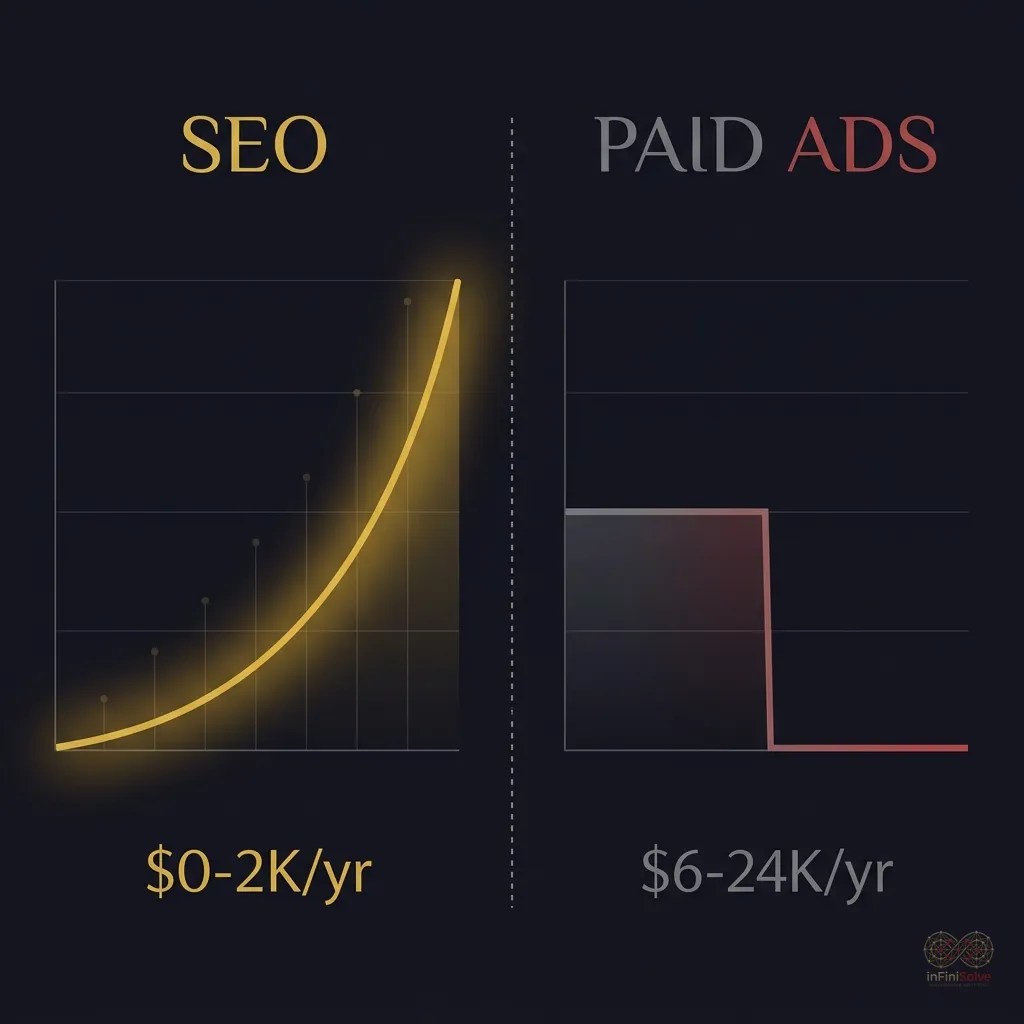
Traditional Conference BD: Attending massive industry days costs between $15,000 and $50,000 annually. It is highly relationship-dependent, requires exhausting physical travel, and takes 6 to 12 months to see a return.
Google Ads (PPC): Running paid search campaigns is highly expensive ($10,000+ per month). The results are immediate, but the absolute moment you stop paying Google, your pipeline instantly and permanently dries up.
SEO & Content Marketing: SEO requires an upfront investment, but unlike wildly expensive paid ads, SEO compounds forever. An authoritative compliance guide written today will continue to aggressively drive federal traffic and generate highly qualified leads for the next five years at absolute zero additional cost per click.
Frequently Asked Questions (FAQ)
Q: How long does it take to see results from GovCon SEO? A: B2B SEO typically takes 3 to 6 months to start ranking for highly specific long-tail keywords, but once established, it provides a compounding source of organic leads that lasts for years.
Q: Can I use SEO to target specific federal agencies? A: Yes. By creating dedicated landing pages focused on specific agency acronyms and their unique strategic pain points (e.g., "IT Modernization Solutions for the VA"), you can capture search traffic from procurement officials within those specific agencies.
Q: How long does it take for GovCon SEO to work? A: SEO is a long-term strategy. While technical fixes can yield quick bumps, establishing true topical authority and ranking for highly competitive federal keywords typically takes 4 to 6 months of consistent, high-quality content generation and backlink building.
Q: Do contracting officers actually click on Google Ads? A: They do, but organic search results are overwhelmingly trusted more than sponsored ads. Many federal networks also employ strict ad-blockers, making organic SEO the only reliable way to reach a CO at their desk.
Q: Should I put my Capability Statement on my website? A: Yes, absolutely. However, do not just upload it as a PDF. Rebuild the entire capability statement as a fully interactive, highly indexable HTML webpage so that Google can read and rank the text within it. You can offer the PDF as a downloadable bonus.
Related InfiniSolve Insights
To further enhance your federal contracting strategy, explore these highly authoritative resources from the InfiniSolve knowledge base: - B2B GovCon Outreach Strategy: Scaling Beyond SAM.gov - How to Write a Winning Capability Statement for Government Contracts - Navigating the GSA Multiple Award Schedule (MAS): A 2026 Strategy Guide
Ready to dominate your sector?
Partner with InfiniSolve to architect a digital footprint that wins contracts and captures market share.
Schedule Strategy Session